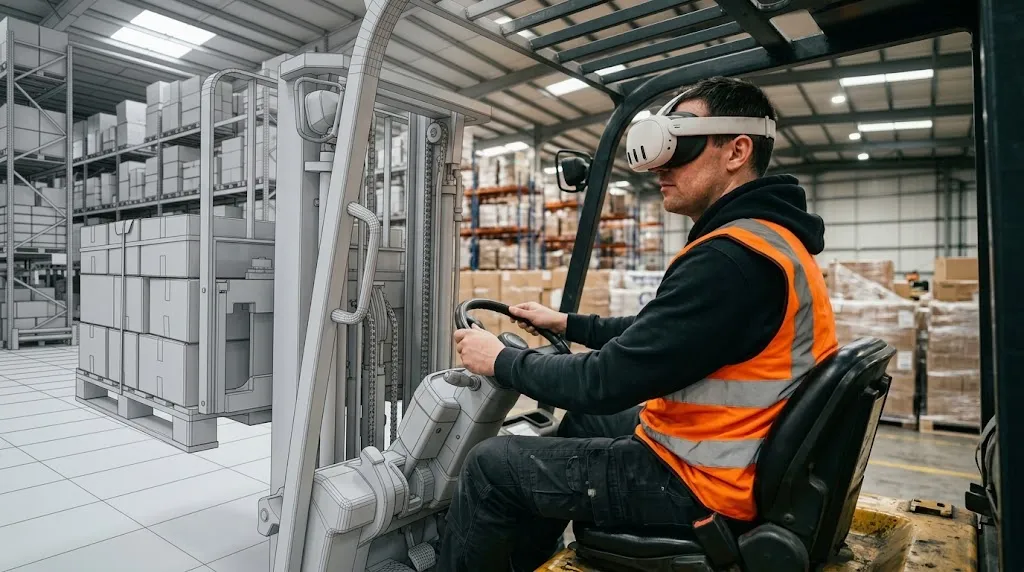
If you’re asked how much it costs to train a technician at your plant, you’ll probably think of the course fee or the trainer’s hours. But that figure is usually just the tip of the iceberg. Beneath the surface lie travel costs, machine downtime, materials used up and risks that nobody factors in.
In this article, we look at the training costs that do not appear under any specific budget heading, the factors you need to take into account when calculating the ROI of virtual training, and why more and more industrial companies are opting for virtual reality training.
The hidden costs of face-to-face industrial training
Traditional industrial training has a direct cost that is easy to calculate and an indirect cost that is rarely measured. These are the main ones:
- Travel and subsistence allowances. Sending technical staff to a training centre, or trainers to each branch, results in a significant increase in travel, accommodation and unproductive hours.
- Machines or production lines at a standstill. To practise on a real machine, you often have to shut it down. And unplanned downtime is costly: according to Siemens’ report The True Cost of Downtime 2024, the world’s 500 largest companies lose almost 1.4 trillion dollars a year due to unplanned downtime – 11% of their revenue.
- Hours spent by expert trainers. Your best technicians stop working to teach, and their availability limits the number of people you can train.
- Material consumption. Parts, consumables or products that are discarded during practical sessions.
- Safety risks. Learning how to handle hazardous equipment or respond to an emergency in a real-world environment involves putting inexperienced people at risk. That is why more and more companies are moving these training activities to virtual environments, as we explain in our article on occupational risk prevention using virtual reality.
Variables for calculating the ROI of virtual training
To compare face-to-face and virtual training fairly, it is advisable to always measure the same variables:
Cost per trained technician
Add up all the costs of the programme (including hidden costs) and divide them by the number of people trained. In face-to-face training, this cost remains almost constant; in virtual training, the initial investment is spread across more learners and the cost per person falls with each new training session.
Time to full charge
How many days or weeks does it take for a new technician to work unsupervised? Every day that this timeframe is reduced represents a gain in productivity and hours of supervision saved. In the PwC study on virtual reality training (which focused on soft skills, but is highly illustrative), trainees who underwent VR training completed the course four times faster than those in a classroom setting.
Scalability
With virtual reality, you can train large numbers of people at the same time and across multiple locations, without having to move anyone around or rely on a trainer’s schedule. The same PwC study calculated that VR training costs the same as face-to-face training for groups of 375 learners or more, and that for 3,000 learners it is 52% cheaper than classroom-based training.
A repeat performance at no extra cost
In a simulator, repeating a procedure ten times costs the same as doing it once. No materials are used up and no machinery is brought to a standstill, so the technician can practise until they have mastered it.
Reducing errors and incidents
Practising beforehand in a safe environment reduces the number of errors when the technician works on the actual machine. Measure the rates of errors, rework and incidents before and after implementing virtual training to quantify these savings.
A simple formula for calculating the ROI of virtual training
The classic return on investment formula applied to training is:
ROI (%) = (Benefits − E-learning costs) / E-learning costs × 100
To fill in your company’s details:
- Costs of virtual training: content development, headsets or equipment, licences and maintenance.
- Benefits: the savings compared to face-to-face training (travel, trainers’ time, materials, production line stoppages), plus the value of the time saved whilst staff become self-sufficient, and the savings resulting from fewer errors and incidents.
- Time horizon: calculate the ROI over one, two and three years. As the virtual training can be reused, the return on investment increases with each new cohort of technicians.
A positive ROI indicates that the virtual training pays for itself within that period. And the more learners, venues or sessions you need, the sooner you’ll reach that point.
Why more and more industrial companies are opting for virtual reality training
As well as the cost savings, there are compelling operational reasons:
- Safety: it enables you to practise dangerous situations without any risk, such as working at height or dealing with emergencies. We explain this in detail in our guide on how to simulate dangerous situations using virtual reality.
- Standardised training: all technicians receive the same course content, to the same standard, at any centre.
- Preserving knowledge: the expertise of the most experienced technicians is captured in the simulator and is not lost when they retire.
- Greater engagement: according to PwC, students trained using VR were 1.5 times more focused than their classmates.
If you’d like to find out more about the benefits, we recommend our articles on the importance of virtual training and immersive onboarding.
How we do it at Innoarea
At Innoarea, we have been developing virtual training simulators for industry for many years, having completed over 200 projects and trained more than 10,000 employees. Our process begins by understanding your specific situation:
- We analyse your current training programme and the costs that you are not currently tracking.
- We design the simulator based on your actual equipment, procedures and risks.
- We roll it out across your sites, with metrics to track each technician’s times, errors and progress.
- We’ll work out the return with you, using your own figures.
Discover our virtual training service and, if you’d like to find out how much it really costs to train your technicians and how much you could save, get in touch with our team. We’ll help you calculate the ROI of virtual training for your business.