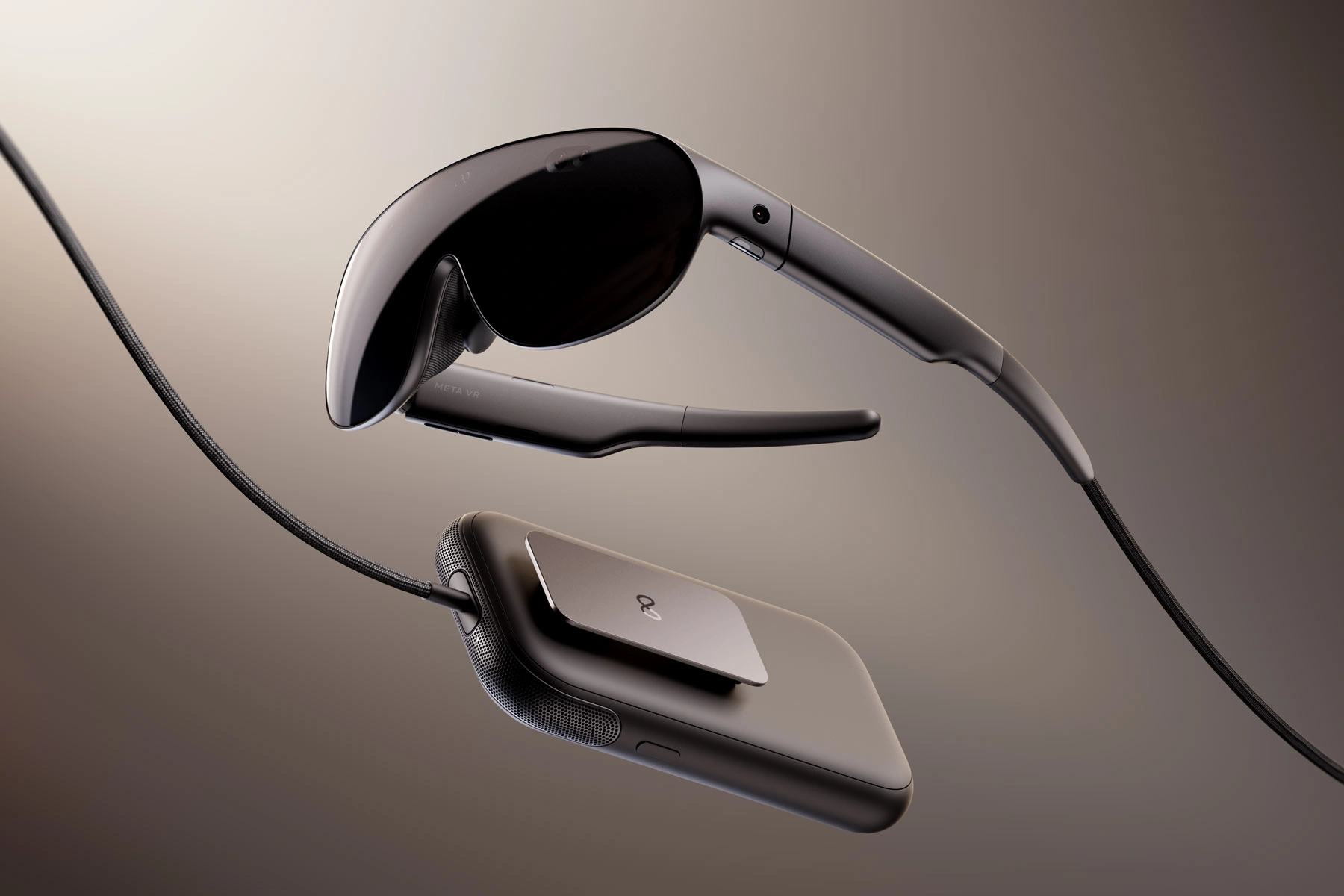
The extended reality ecosystem has just taken a giant leap forward. Meta has taken the tech world by surprise with the announcement of its new Meta VR Glasses, a revolutionary mixed reality headset that promises to blur the line between the physical and digital worlds once and for all. Scheduled for release in spring 2027, these lightweight glasses aim to make immersive technology accessible to everyone, with a design that is truly focused on real-world usability and user comfort.
Below, we take a detailed look at what makes these new glasses so special and why they could be the definitive turning point for the widespread adoption of mixed reality in corporate, educational and entertainment settings.
What are Meta VR Glasses? An overview
Known internally during their development as Project Phoenix or Meta Quest Air, the Meta VR Glasses are the most advanced virtual and mixed reality headset created to date by Mark Zuckerberg’s company. Unlike the bulky VR headsets that dominate the current market, this new hardware takes the form of conventional glasses. They are designed to integrate immersive technology into a much more open and natural format, running on the HorizonOS operating system to ensure compatibility with the vast existing Meta Quest catalogue.
100 grams that change the game
The biggest obstacle to the adoption of virtual reality has always been ergonomics. Meta has solved this problem in one fell swoop: the Meta VR Glasses are made from a premium magnesium alloy, bringing the weight down to just 100 grams.
To put this into perspective, they are five times lighter than the current Meta Quest 3 and a far cry from the just over half a kilo weighed by the Apple Vision Pro. This ultra-lightweight design allows users to learn, play or work at virtual desks for hours on end without suffering from the dreaded neck strain. What’s more, they feature an open design that allows users to see their real surroundings naturally, although they include an optional magnetic light blocker for moments that require total immersion.
Technical specifications of the Meta VR Glasses
To achieve this design milestone without compromising on performance, Meta has equipped these glasses with cutting-edge hardware that places them squarely in the top tier of the XR market.
Cinema-quality visuals: 5K Micro-OLED screens and pancake lenses
The visual experience is unprecedented in such a compact format. The Meta VR Glasses are equipped with Infinite Display technology, featuring 5K micro-OLED panels (resolution of 2,412 x 2,288 pixels per eye). This extremely high pixel density of 37 pixels per degree (PPD), combined with Pancake-style optics, guarantees exceptional clarity. The result is so impressive that they are IMAX Enhanced and Dolby Vision certified, making them the perfect canvas for reading complex technical documents, working with 3D industrial models or enjoying the best in portable cinema.
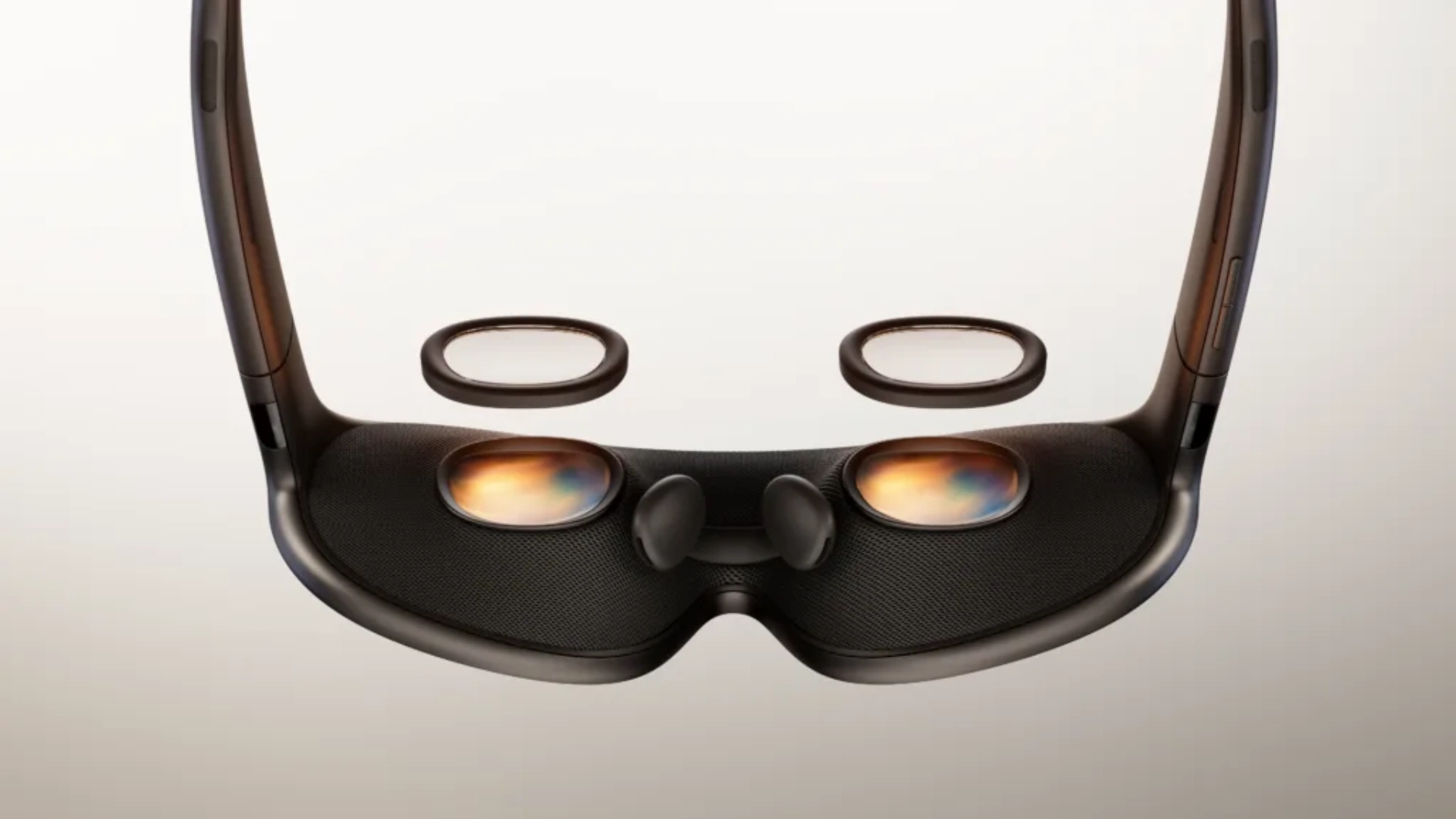
External module (‘Puck’): The perfect balance between weight and performance
How is it possible to integrate 5K displays and tracking sensors into a device weighing just 100 grams that sits on the face? The key to its architecture lies in its split design. The glasses are connected via an ultra-thin optical cable to an external processing module, known as the “puck”.
This disc, which weighs around 300 grams (similar to a large smartphone), houses the device’s ‘brain’ and its battery, which offers up to three hours of battery life with support for 45W fast charging. Thanks to a built-in clip, the user can conveniently clip it to their belt or slip it into a pocket, relieving the headset of the full weight of the battery and processors.
Natural Control and AI: Eye Tracking, Gestures and the Snapdragon XR2 Gen 3 processor
Inside this pocket-sized device beats the incredibly powerful Qualcomm Snapdragon Reality Elite (XR2 Gen 3) processor, backed by 12 GB of RAM and up to 1 TB of internal storage.
In terms of usability, the interaction is truly magical. Although they are compatible with Touch Plus controllers, the Meta VR Glasses are designed to be used without controllers. Thanks to a four-camera system, they offer eye tracking and full hand and gesture recognition. As if that weren’t enough, they feature Muse, Meta’s artificial intelligence agent. Using voice commands, the user can ask the AI to reorganise their virtual workspace, open documents or play a video, making the learning curve as simple as possible for anyone.
Comparison: Meta VR Glasses vs the industry-leading headsets
The mixed reality and spatial computing market has entered a phase of maturity in which ergonomics and value for money are key competitive advantages. Whilst previous offerings relied on all-in-one head-mounted displays, the Meta VR Glasses redefine the standard by shifting the weight of the processor and battery to an external, pocket-sized module.
To understand how this new device compares with the competition, we have compared the key specifications of the industry’s leading models:
| Meta VR Glasses | Apple Vision Pro | Samsung Galaxy XR | Meta Quest 3 | |
|---|---|---|---|---|
| Heaviness in the face | 100 g (+ 300 g puck) | 600–650 g | 545 g (+ 302 g battery) | 515 g |
| Estimated price | $1.299 (~1.400 €) | $3.499 (~4.000 €) | $1.799 (~1.800 €) | $499 (~549 €) |
| Display technology | Micro-OLED 5K | Micro-OLED 4K | Micro-OLED 4K | LCD |
| Estimated resolution | 2.412 x 2.288 | 3.660 x 3.200 | 3.552 x 3.840 | 2.064 x 2.208 |
| Processor | Snapdragon XR2 Gen 3 | Apple M2 + R1 | Snapdragon XR2+ Gen 2 | Snapdragon XR2 Gen 2 |
| Operating System | HorizonOS | visionOS | Android XR | HorizonOS |
| Interactivity | Ocular, gestures, AI and Quest controllers | Ocular and gestures | Ocular, gestures, voice and controllers | Touch Plus controllers and gestures |
| Autonomy | Up to 3 hours | 2 – 2,5 hours | 2 – 2,5 hours | 2 – 2,5 hours |
Other features and new developments in the Meta VR Glasses
Beyond its graphics power and ultra-lightweight design, the true potential of this headset lies in how it transforms our surroundings, both for home entertainment and in our day-to-day professional lives. Meta has integrated tools that make these glasses a versatile device, ready for any situation.
Infinite Virtual Office: Multiple monitors and Surface Keyboard technology
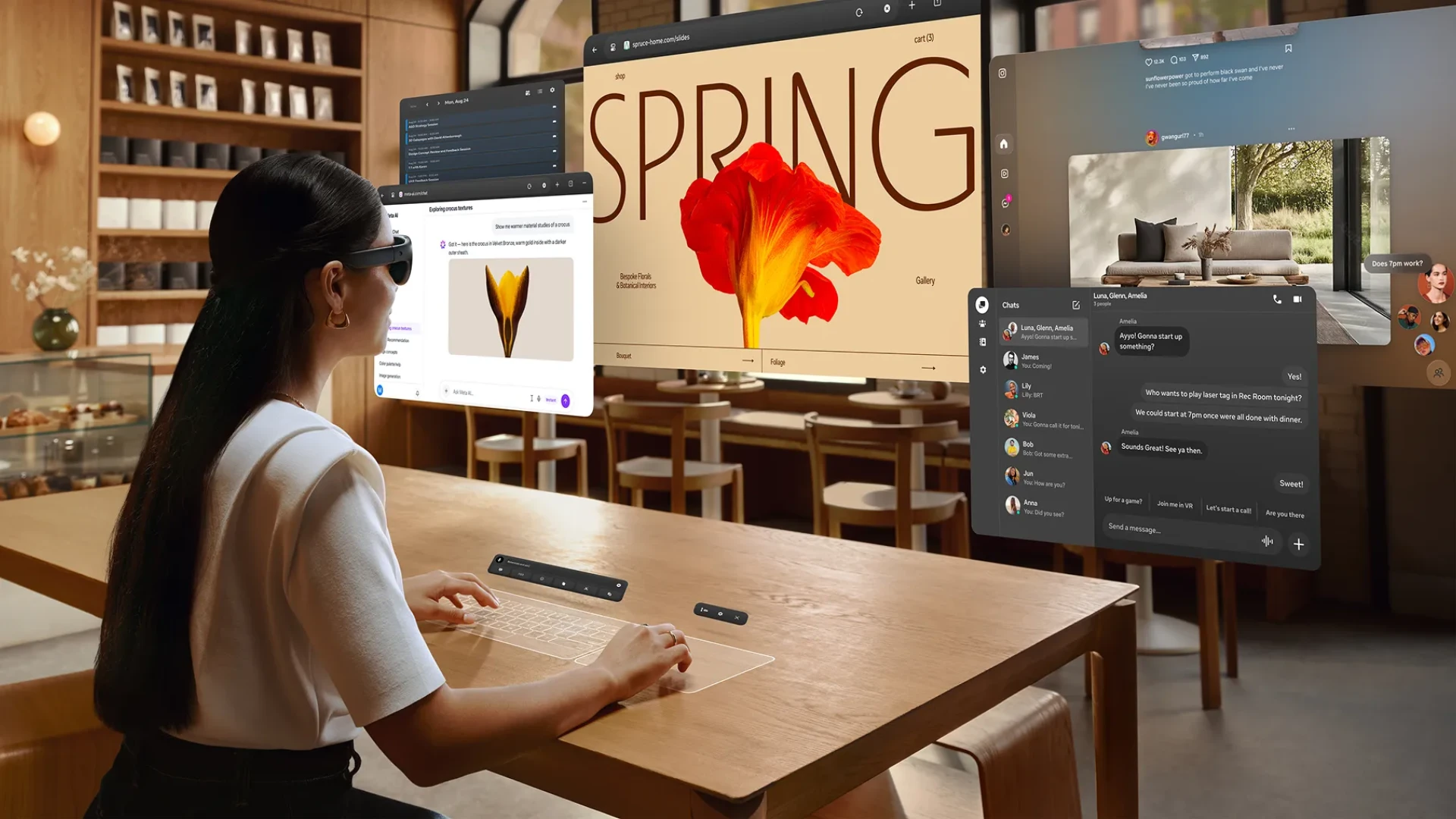
Can you imagine being able to carry your setup with multiple screens in your pocket? The Meta VR Glasses allow you to stream multiple virtual displays wirelessly directly from your PC, Mac or mobile phone. What’s more, they feature a direct DisplayPort input via their USB-C port, making them ideal for connecting without latency to work laptops or even games consoles.
But the real revolution in usability comes with Surface Keyboard technology. The glasses can transform any flat surface – such as a train table, a café counter or a desk – into a virtual keyboard and trackpad. Although it lacks physical haptic feedback, it is a brilliant solution for working, browsing the internet or chatting whilst travelling or at specific times, without having to carry extra accessories.
Photorealistic collaboration and video calls with Hologram avatars
The way we communicate remotely is also taking a spectacular evolutionary leap. Meta’s new glasses incorporate Hologram, the eagerly awaited technology that Reality Labs has been developing since 2019 under the name Codec Avatars. This innovation allows a life-size, photorealistic avatar of the person you are talking to to be projected during voice and video calls.
Whether it’s chatting to a family member on the other side of the world whilst feeling as though they’re sitting in your own living room, or holding a crucial meeting with clients whilst projecting a hyper-realistic presence, this feature definitively breaks down the barriers and dispels the coldness of traditional two-dimensional screens.
The immersive future is already here
The Meta VR Glasses mark a genuine turning point by bringing mixed reality to life in a lightweight design weighing just 100 grams. Their combination of 5K Micro-OLED displays, gesture control and artificial intelligence demonstrates that spatial computing is no longer a distant promise, but an everyday technology capable of revolutionising both home entertainment and productivity and communication in the workplace.
At Innoarea, we combine efficiency, creativity and technological expertise to turn innovations like this into competitive advantages. Whether it’s to create digital and immersive experiences for events and marketing, optimise training and on-site work processes, or drive the global digital transformation of your business, there’s no need to wait for future hardware launches to lead your sector. Get in touch with our team and find out how we can help you take your brand or business to the next level.